Cleartax – Germany

Best e-Invoicing software in Germany with XRechnung & ZUGFeRD support

Listed on 𝐕𝐞𝐑, Germany's leading e-invoicing association

AI-powered seamless integration with any ERP/POS systems

Single unified Global e-Invoicing API, to support 40+ country mandates
Trusted by 5000+ global enterprises






Germany e-invoicing at a glance
From January 2025, all B2B businesses in Germany must be able to receive structured e-invoices under the Wachstumschancengesetz (Growth Opportunities Act). The obligation to issue e-invoices is phased: large enterprises from January 2027, all others from January 2028. Only EN 16931-compliant formats (XRechnung, ZUGFeRD 2.x) are accepted — PDFs alone will no longer qualify.

Structured B2B invoicing, not PDFs
Germany’s mandate makes structured e-invoices the default for domestic B2B. A PDF alone does not qualify, and paper or PDF invoicing is only possible if the buyer explicitly agrees. In practice, finance teams must reliably receive, read, validate, and process e-invoices end to end.

EN 16931 formats: XRechnung or ZUGFeRD
A compliant German e-invoice must follow EN 16931 and be machine-readable. Most businesses use XRechnung (XML) or ZUGFeRD 2.x (PDF with embedded XML). The XML data is the compliant core, so missing or incorrect structured fields can lead to rejection and payment delays.

Direct exchange with audit-ready archiving
Germany uses a peer-to-peer model for B2B e-Invoicing with no central portal. Partners can exchange via email, EDI, Peppol, or portals, as agreed. Compliance depends on strong operations such as validation checks, exception handling, and archiving the original structured invoice file in an audit-ready way.
Get e-invoicing ready in 5 steps
Internal Assessment
Platform & Vendor Shortlisting (RFP)
Compliance Readiness Review
Integration & Testing
Supplier Onboarding & Enablement
Internal Assessment
Platform & Vendor Shortlisting (RFP)
Compliance Readiness Review
Integration & Testing
Supplier Onboarding & Enablement

How ClearTax supports the Germany’s e-invoicing Mandate
One dashboard - Multi Channel
ClearTax centralises invoices across email, EDI, Peppol and portal-led workflows into one dashboard, so no e-invoice gets missed and finance teams get one operational view across incoming and outgoing flows.
Enterprise‑grade security, uptime and analytics
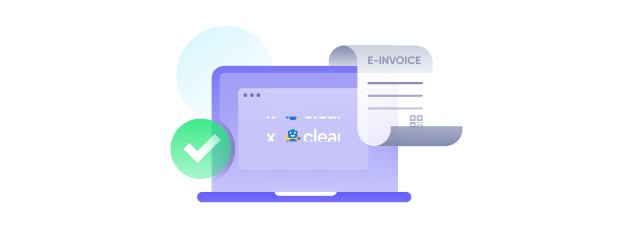
Enterprise‑grade security with ISO 27001, SOC‑2, GDPR alignment, EU data residency, VAPT and role‑based access controls. Near real‑time monitoring and rich MIS dashboards to catch errors early and support VAT‑safe e‑invoicing.

Built for structured formats
ClearTax supports EN 16931-aligned invoice handling for XRechnung and ZUGFeRD, plus Peppol-based exchange where counterparties require it, with validations that catch missing fields and logic errors before they become buyer rejections or AP exceptions.
Germany now. ViDA next.
With ViDA formally adopted in March 2025 and cross-border digital reporting and e-invoicing changes rolling out toward 2030, ClearTax gives multinational teams one platform for Germany and what comes next across Europe
Compliance without repeated ERP rewrites
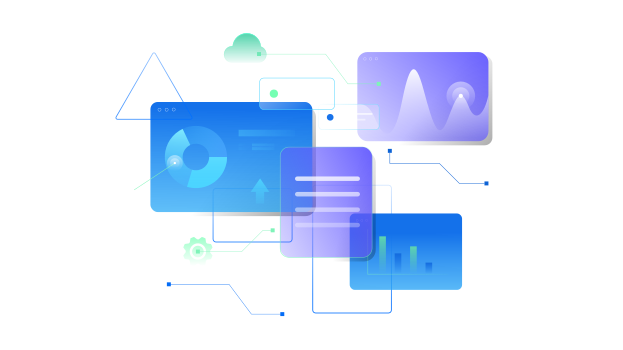
Germany’s mandate is still evolving through guidance updates and transition phases, and businesses with public-sector exposure also need to handle separate B2G obligations. ClearTax absorbs regulatory changes on the platform side, reducing ERP churn, implementation overhead and long-term compliance risk as rules mature
 GDPR compliant
 ISO 27001 certified
 VAPT audited
 SOC 2 compliant
 Accredited by ZATCA, FTA, LHDN, MARC, SIS
 Open PEPPOL Access Point
Germany e-invoicing resource centre
Germany e-invoicing mandate readiness checklist

Transforming E-Invoicing for Belgium’s Largest Conglomerate

E-Invoicing in Germany: Obligations, Timeline, Requirements, Format & Examples
XRechnung e-Invoicing Format? How to Create, Examples, Specifications
Global E-Invoicing Mandates
The hidden risks of Germany’s e-Invoicing mandate most enterprises miss
Why global leaders choose clearTax
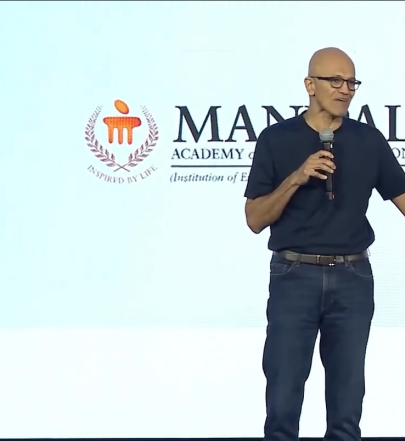
Satya Nadella on tax filing by ClearTax
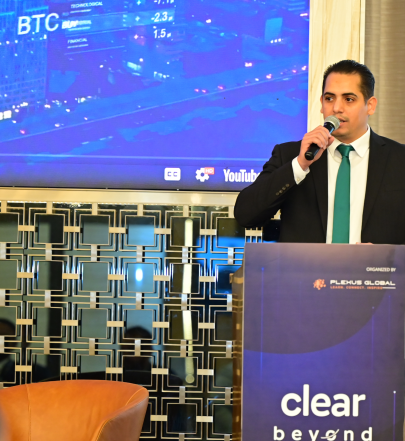
Connect, learn, succeed with ClearTax

#InClearConversation with industry leaders

ClearTax is simplifying e-Invoicing. They enabled us to implement the e-Invoicing system in time and handled all our business complexities with ease. Thank you for the effort and good job!


Raj Kiran
Head, Taxation & Retail Finance, Puma (India)
We appreciate ClearTax for successfully completing the complex ZATCA E-Invoicing Phase II Integration project. Their platform enabled seamless management of multiple business units. Kudos to the team for their timely delivery.


Abdulbary Atassi
DIRECTOR OF IT, Zamil Industrial (KSA)
Collaborating with ClearTax was an exceptional experience. They streamlined the entire process, even under tight deadlines, worked closely to address the unique challenges of e-invoice integration with our diverse ERP systems.


V Bharathy
Manager, Finance Applications, Gamuda Land (Malaysia)
ClearTax has transformed the way we handle GST compliance. Real-time creation of e-Invoices and e-Way bills plays a significant role in providing us with critical insight into our business.

Pratush Kumar
DGM-IT, JK Tyre (India)
Want a readiness walkthrough for your enterprise?
Frequently asked questions.


Cleartax is a product by Defmacro Software Pvt. Ltd.

Your data security and privacy matter most to us.